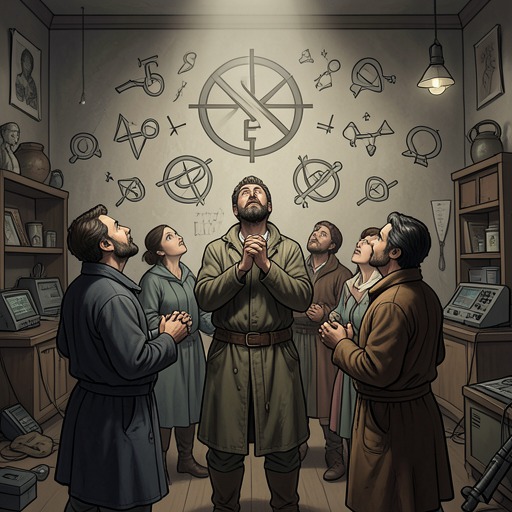
The Gospel
The Social ContractThe Gospel, in this political argument, names a religion of universal brotherhood and inward moral duty, distinct both from national civic cults and from institutional Christianity. Its reach across political boundaries is also its political limitation: it recognizes every person as kin, yet does not bind citizens’ hearts to the state or strengthen its laws.
A universal religion
The Gospel in its pure form belongs to the religion of humanity rather than to a particular nation. It has no temples, altars, or rites; its worship is inward, directed to the supreme God, and expressed through the eternal obligations of morality. Because all people are children of one God, they recognize one another as brothers, and their fellowship persists beyond death.
This universality distinguishes the Gospel from the early religions of peoples, whose gods and prescribed public rites belonged to a single country. Civic religion makes the nation the sphere of religious duty; the Gospel instead extends brotherhood beyond national boundaries. The contrast is not simply between different beliefs, but between different ways religion can organize political belonging.
Religion and political cohesion
The Gospel’s moral teaching does not, in this account, add force to the laws of a political community. It has no particular relation to the body politic and leaves the laws to stand on their own. More sharply, by directing believers away from earthly things, it draws their hearts from the state rather than attaching them to it. The text therefore rejects the claim that a society of true Christians would automatically form a perfect political society: in its formulation, such a society would cease to be a society of men.
That political weakness is connected to the Gospel’s lack of a national religion. The account denies that a holy war can properly be Christian, because the Gospel establishes no national cult around which a people might fight. The Crusaders are consequently described not as Christians in this political sense but as soldiers of the priests, fighting for the Church’s spiritual country after it had been made temporal. The distinction separates the Gospel’s universal fellowship from warfare conducted in the name of an institution.
Institutional Christianity and the state
The text distinguishes the Gospel from the Christianity of its own day. Institutional Christianity is classified as a priestly religion because it gives people two legislative codes, two rulers, and two countries, setting religious and civic obligations against one another. Such divided allegiance makes it impossible to remain faithful to both religion and citizenship.
This distinction also informs the discussion of soldiers. Christian troops under pagan emperors are said to have been brave through emulation of pagan troops; after the emperors became Christian, that emulation disappeared, and Roman valour is described as having vanished with the eagle displaced by the Cross. The example supports the argument that the political effects attributed to Christianity depend on its institutional relation to the state, not simply on the moral content of the Gospel.
Political significance
The Gospel’s universal ethics and its political insufficiency are held together rather than reconciled. Its brotherhood survives political divisions and even death, but precisely because it is not a particular civic bond, it cannot supply the state with the attachment to law that civic religion provides. The work thus uses the Gospel to distinguish moral community from political cohesion, while refusing to treat the two as interchangeable.